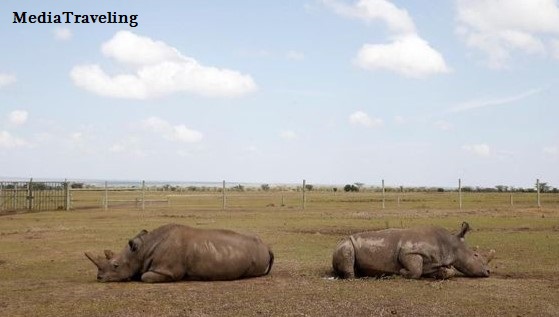
Indonesia has Pahu and Pari Mahulu. Africa has Najin and Fatu. These four female rhinos live worlds apart, yet share the exact same fate: they represent the last remaining hope for their species’ survival.
Their stories play out across two different continents, but both illustrate how a species can end up on the edge of extinction after decades of steady population decline. The Bornean rhino (Dicerorhinus sumatrensis harrissoni) and the northern white rhino are both now in an extremely critical state.
Indonesia’s Last Hope: Pahu and Pari Mahulu
In Indonesia, the last hope for the Bornean rhino rests on two individuals: Pahu and Pari Mahulu. Pahu currently lives at the Kelian Rhino Sanctuary in West Kutai, East Kalimantan. Pari Mahulu, meanwhile, originates from the interior region of Mahakam Ulu and is now part of a rescue program supporting long-term conservation efforts.
Africa’s Story: Najin and Fatu
In Africa, the situation is no less alarming. The northern white rhino, once found across several countries, is now down to just two surviving individuals, both female, named Najin and Fatu, living at Ol Pejeta Conservancy in Kenya. No males remain.
As the last individuals of their bloodline, Najin and Fatu are protected with extraordinary levels of security. Armed guards keep watch 24 hours a day to ensure their safety from poaching threats. At the same time, scientists continue racing to save the species through assisted reproductive technology.
Why the Two Species Face Different Odds
Dr. Muhammad Agil, a lecturer at IPB University’s Faculty of Veterinary Medicine, said the stories of both species illustrate just how fragile animal populations become once numbers continue declining and genetic diversity narrows further.
Despite both species being down to just two individuals each, their paths to potential rescue differ significantly. For the northern white rhino, researchers still have preserved genetic material from several deceased males. This material is now being used to develop in vitro fertilization (IVF) technology and lab-grown embryos.
According to Agil, advances in modern conservation technology have created possibilities that simply didn’t exist before. As long as biological material remains available, there’s still hope for developing various species-rescue technologies.
“If the biological material still exists, there’s still a chance it can be further developed using technology available in the future. But once everything is gone, that possibility disappears along with it,” Agil told mediatravel on Tuesday, September 22, 2026.
A Warning Rooted in Painful History
That warning isn’t hypothetical. Indonesia has already lost the Bali tiger, the Javan tiger, and the Javan stingray. These three species now exist only in photographs, archives, scientific records, and museum collections.
Even more troubling, according to Agil, these lost species no longer have any biological or cellular material that could be used for modern conservation technology.
“These animals don’t even have biological or cellular material left that could be used for modern conservation technology development. They’re truly extinct, nothing remains,” Agil said.
A Call to Act Before It’s Too Late
Because of this, Agil stressed that conservation efforts shouldn’t wait until a species’ population dwindles down to a handful of individuals. Once numbers drop that low, rescue efforts become far more difficult, far more expensive, and often dependent on technology with uncertain success rates.
This lesson also applies directly to Indonesia, which still has both Javan rhinos and Sumatran rhinos remaining. “Habitat protection, population management, and the use of conservation technology need to be strengthened starting now, so these species don’t follow the same path as those we’ve already lost,” Agil emphasized.
Why This Matters Beyond Science
The parallel stories of Pahu, Pari Mahulu, Najin, and Fatu serve as a sobering reminder that extinction rarely happens overnight, it’s the slow result of decades of habitat loss, poaching, and delayed intervention. For Indonesia specifically, with the Javan and Sumatran rhinos still holding on, the message from conservationists is clear: the time to act decisively is now, while there’s still genetic material, still individuals, and still a real chance to change the outcome.