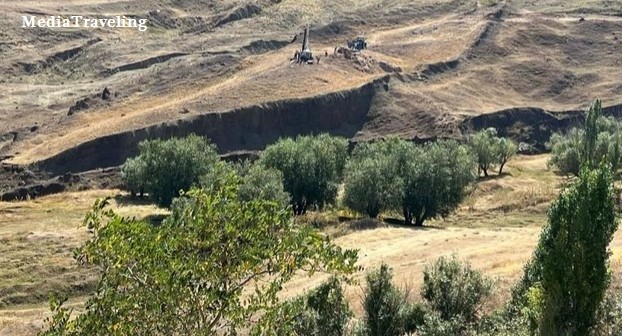
A ship-shaped formation near Mount Ararat in Turkey is back in the spotlight. An international research team has begun collecting samples to investigate the Durupinar Formation, a site long linked in popular imagination to Noah’s Ark.
What Is the Durupinar Formation?
The Durupinar Formation is a boat-shaped structure roughly 157 meters (about 515 feet) long, located in eastern Turkey. For decades, its resemblance to a giant ship hull has drawn attention from history lovers, religious travelers, and mystery hunters alike.
The formation sits in Ağrı Province, about 30 kilometers south of Mount Ararat. Standing at 5,137 meters, Ararat is Turkey’s highest peak and has been associated with the story of Noah’s Ark for centuries in Jewish, Christian, and Islamic traditions.
How to Visit the Site
Climbing Mount Ararat requires serious preparation, but the Durupinar Formation is far easier to reach. According to several sources, visitors can drive to the national park area and take a short walk to an observation deck facing the formation. From there, the structure’s hull-like shape stands out clearly against the hilly landscape of eastern Turkey.
New International Research Project Underway
The site has grown busier lately as an international research project, approved by the Turkish government, gets underway. Scientists from several disciplines have been conducting field surveys to gather fresh data.
The latest study is led by Noah’s Ark Scans, a research and exploration organization based in California, USA. Its team of archaeologists, geologists, and soil experts has started extracting core samples from a depth of around 18 meters for further analysis.
The team is also using ground-penetrating radar (GPR) to study what lies beneath the surface of the formation.
A Long-Running Scientific Debate
The Durupinar Formation has been debated among scientists for years. In 1996, geologist Lorence Collins and explorer David Fasold concluded that the site was entirely a natural rock formation, and that the theory tying it to Noah’s Ark was untrue.
Noah’s Ark Scans believes many questions remain unanswered. In a statement on Wednesday, September 23, 2026, reported by Newsweek, the group said skeptics have long offered one simple explanation: that the formation is just solid natural rock.
Testing the “Solid Rock” Explanation
The team says its main goal is to test that explanation directly. It has posed several questions the research aims to answer:
- Is the formation a single, homogeneous mass of natural rock?
- Does it contain any internal structure?
- Where does the true bedrock lie beneath it?
- How does that bedrock continue into the surrounding valley?
- Early Radar Results Spark Interest
Andrew Jones, founder of Noah’s Ark Scans, said preliminary radar data has produced interesting results that do not fully support the idea that the formation is ordinary rock. According to Jones, a radar survey conducted with Bakhtar Research and Engineering LLC found no sign of a simple, homogeneous rock mass at the site.
What Happens Next?
The research is still at an early stage, and results from the core samples have not yet been announced. Independent scientific review will also matter, since the early radar findings are preliminary and come from a group with a stated interest in the site’s mystery. Still, the drilling marks the latest step in efforts to uncover the truth behind one of the world’s most debated geological curiosities.
For travelers, the formation remains an accessible stop for anyone drawn to Turkey’s blend of geology, faith, and legend. Whatever the lab results show, the Durupinar Formation is likely to keep inspiring curiosity and debate for years to come.