Before it became the Pancasila Sakti Monument complex, the Lubang Buaya area was once home to 13 houses surrounded by rubber plantations. After the monument was built, only three of those original houses remained, standing today as silent witnesses to the G30S/PKI tragedy of 1965.
From a Quiet Village to a National Monument
During a visit to the site, mediatraveling spoke with Marine Major Masnen, Head of the Collections Subdivision at the Pancasila Sakti Monument, who revealed that the Lubang Buaya area originally contained 13 residential buildings before the monument was constructed.
“Before the monument was built, the area was only 5 hectares. Within it, there were 13 residential homes, housing 13 families. After the September 30th Movement occurred, a monument was built, and 10 of those houses were demolished to make way for it,” Major Masnen explained.
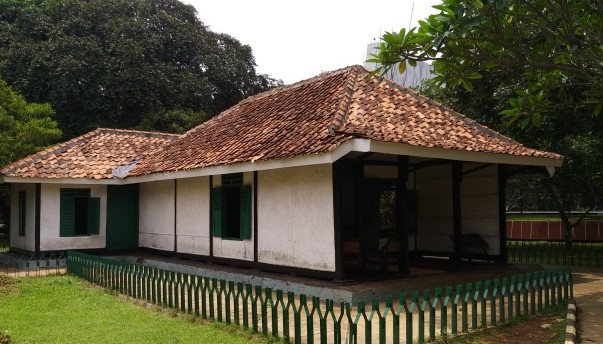
According to Masnen, only three houses remain standing in the Lubang Buaya area today. These surviving structures, which visitors can still see, include the torture house, the command post house, and the communal kitchen house.
“Only three houses remain: the torture house, the command post house, and the communal kitchen house, because these three houses were the ones actually used during the September 30th Movement,” he added.
These three buildings have been preserved as historical evidence of the 1965 events, widely known in Indonesia as the G30S/PKI movement. Each of the surviving houses served a distinct function during that period.
The Torture House
Before the G30S/PKI uprising, this building served as a classroom for a local people’s school, equivalent to today’s elementary school. During the uprising, it was converted into a site where kidnapped Indonesian Army (TNI AD) officers were held captive and tortured while still alive.
Several senior Army officers targeted by the PKI (Indonesian Communist Party) were kidnapped and brought to this house, including Lieutenant General Ahmad Yani, Major General R. Soeprapto, Major General M.T. Haryono, Major General S. Parman, Brigadier General Sutoyo Siswomiharjo, Brigadier General D.I. Pandjaitan, and First Lieutenant Pierre Tendean. These officers endured horrific torture at the hands of their captors.
The torture was reportedly carried out in an effort to extract information. Today, the torture house stands as a silent witness to the brutality that unfolded there during that dark chapter of Indonesian history.
The Command Post House
The Command Post building remains largely in its original condition. Stepping inside, visitors can still sense the atmosphere of the past. Original items on display, including three kerosene lanterns (petromax lamps), a sewing machine, and a glass cabinet, help convey the somber mood of that period.
On September 30, 1965, this house served as the command headquarters for the PKI group that planned the kidnapping of Army officers. The Command Post House remains preserved as a key piece of evidence at the Pancasila Sakti Monument.
The Communal Kitchen House
On October 1, 1965, this house functioned as a communal kitchen for members of the G30S/PKI rebel forces. Several original items remain on display, including a table, chairs, a wardrobe, a bed, cooking pans, and large steaming pots, offering visitors a tangible glimpse into daily life at the site during that time.
Visiting the Site Today
This historical site is located within the Pancasila Sakti Monument complex on Jl. Lubang Buaya, in the Lubang Buaya subdistrict, Cipayung, East Jakarta. The complex also houses the Lubang Buaya “Well of Death,” the site where the bodies of several kidnapped Army officers were ultimately disposed of following their torture and execution.
For travelers interested in Indonesian history, the Lubang Buaya area offers a preserved, sobering window into one of the country’s most significant and tragic historical events. Visiting these remaining structures provides an opportunity to reflect on this difficult chapter of Indonesia’s past, directly at the site where it unfolded.