Receding water levels at Gajah Mungkur Reservoir (WGM) have caused ancient graves to resurface, including the tomb of Eyang Raden Santri. What’s the story behind it?
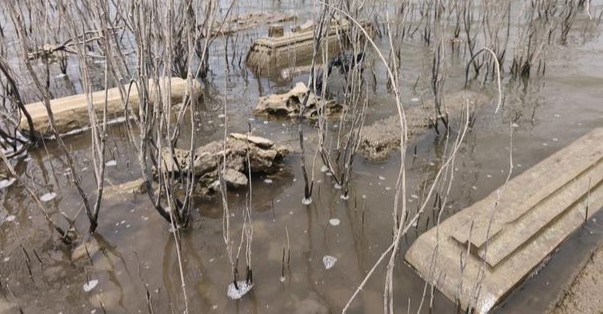
Rectangular, cream-colored stones can be seen scattered along the edge of Gajah Mungkur Reservoir in Wuryantoro Village/District, Wonogiri Regency, Central Java.
These stones are gravestones from an ancient cemetery submerged at the bottom of the reservoir. The gravesite sits roughly 500 meters from the Wuryantoro Village Office. However, reaching the graves is fairly difficult, as they’re located in the middle of the receded reservoir.
Around the ancient graves, many residents can be seen going about their daily activities, such as fishing and farming, seemingly unbothered by the presence of the gravestones.
Up close, some gravestones remain intact, while others have eroded over time. Their lengths vary, ranging from half a meter to two meters. Most of these limestone-like gravestones feature a small hole in the center.
Although some gravestones have become fully visible as the reservoir’s water level dropped, others remain partially submerged. Several stones feature carved inscriptions, though most have become too eroded to read.
An Annual Dry-Season Phenomenon
Soemardjono Fadjari, Head of Wuryantoro District, said the appearance of these ancient graves at WGM is an annual phenomenon that occurs during the dry season.
“Every dry season, these graves usually start becoming visible. But only some of them so far, since the water level is still fairly high,” Soemardjono said when contacted by reporters on Wednesday (September 9, 2026).
He said the ancient graves typically start appearing around August. This year, however, that didn’t happen until September.
“Usually they start showing by August. This year, the water receded a bit slower, so not all of them have surfaced yet,” he said.
The Legend of Eyang Raden Santri
One of Wuryantoro’s community elders, Suparso, 77, said the cemetery was once located in Sentono Hamlet, Ngungkingsari Village. While it houses the historic grave of Eyang Raden Santri, the cemetery complex actually served as a general burial ground for Sentono residents.
“It used to be a village cemetery, but it became known because of its elder, named Eyang Raden Santri. The grave was also used by his family, his children and grandchildren, and it became a public cemetery too,” Suparso told reporters on Wednesday (September 9).
According to Suparso’s account, Eyang Raden Santri was a local villager, an ordinary farmer. One day, while digging an irrigation channel near his rice field, a man came by and walked straight through the channel he was building.
“Eyang Raden Santri scolded him, worried the channel would be damaged. The man told him to check again, to see whether walking through it had actually caused any damage,” Suparso recounted.
Eyang Raden Santri checked his field again and found no damage to the irrigation channel. Feeling something was strange, he decided to chase after and follow the mysterious man.
Once he caught up, the man scolded Eyang Raden Santri for following him. Believing the man possessed extraordinary powers, Eyang Raden Santri insisted on accompanying him. The man then took him to the Bengawan Solo river, building a raft for Eyang Raden Santri to ride.
“If you want to come with me, I’ll build you this raft. Once the raft starts moving, you’re not allowed to get off until it stops on its own,” the former puppeteer told him, according to the story.
Eyang Raden Santri followed the man’s instructions. On this simple raft, he traveled down the Bengawan Solo for several days until it stopped at Keblokan Hamlet, Sendang Ijo Village, Selogiri District, Wonogiri.
There, local residents found Eyang Raden Santri weak and exhausted, having gone without food for days. In Keblokan, he was given food until his physical condition recovered.
“There, in Keblokan, Eyang Raden Santri converted to Islam and was taught to recite verses from the Quran. After that, he was told to go home and spread the teachings of Islam. That’s when he took on the name Eyang Raden Santri,” Suparso explained.
“As for the man Eyang Raden Santri followed, we believe he was one of the Wali Songo, perhaps Sunan Kalijaga, or Sunan Giri,” he added.
A Respected Figure, Now Resting Beneath the Reservoir
Back in Sentono Hamlet, Eyang Raden Santri went on to spread the teachings of Islam. Through his religious teachings, he became one of the community’s most respected figures.
When he passed away, he was buried in what is now the site of the WGM reservoir project. Suparso said many pilgrims used to visit Eyang Raden Santri’s grave.
“I used to go for nyadran (pilgrimage visits) there, the grave was quite large. Before people went to the mosque, it was also used for topobroto (spiritual retreat). Pilgrims came from all over,” he said.
Villages Submerged for the Reservoir Project
As is widely known, the construction of the Gajah Mungkur Reservoir submerged 51 villages across 7 districts in Wonogiri Regency, built between 1974 and 1981. The project also relocated residents and graves from Sentono Hamlet. Suparso said the village’s residents were relocated to Jambi, while the graves were moved to an area near the Wuryantoro Village Office.
“The old gravestones were discarded, and new, nicer gravestones were built at the new location. That includes Eyang Raden Santri, whose remains were also relocated. The grave there, at WGM, is now empty, everything has already been moved,” he concluded.