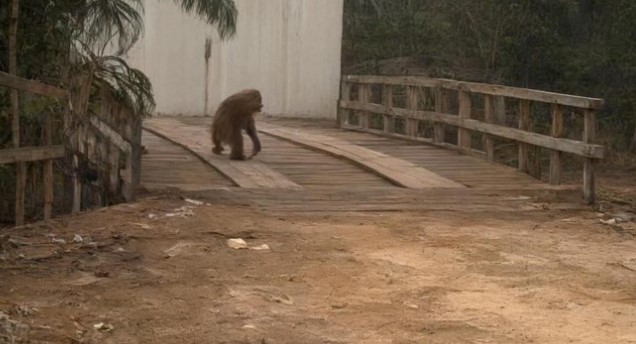
Sometimes a single image tells a story that statistics and reports simply can’t capture. This week, that image came from Central Kalimantan, where a wild orangutan was caught on camera foraging for food along Pangkalan Bun-Kotawaringin Lama Road in West Kotawaringin Regency. The likely reason behind this unusual sighting? Its natural habitat had been consumed by forest fires.
A Sight That Shouldn’t Be Normal
This encounter happened on Tuesday (October 13) and immediately caught the attention of local residents. There’s a good reason for that reaction. Orangutans are supposed to live deep within forest habitats, not pacing back and forth along roadsides where cars pass by regularly.
A local resident named Sano shared what he witnessed that day, describing a moment that captures both human kindness and the desperation of a displaced animal. According to his account, a woman who felt sympathy for the orangutan stopped her vehicle and left some fruit for it.
“There was a woman who stopped and gave some fruit, just placed it there. The orangutan backed away at first, but not long after, it came back and took the fruit,” Sano recounted on Wednesday (October 14, 2026).
Why Is This Happening?
The underlying cause here points to something much larger than just one wandering animal. Wildlife officials suspect this orangutan ventured into human settlements specifically because food sources have become scarce within its natural habitat, likely a direct consequence of the forest fires that have been affecting the region.
While the instinct to help, like that woman offering fruit, comes from a genuinely good place, wildlife experts are raising concerns about the risks involved when wild animals like orangutans appear near roadways. These situations carry potential dangers for both the animal itself and for drivers or pedestrians who might encounter it unexpectedly.
What Officials Are Asking the Public to Do
Handi Nasoka, who heads the Natural Resource Conservation Section (KSDA) for Region II Pangkalan Bun under the Central Kalimantan KSDA Office, is urging communities to report sightings immediately whenever they encounter orangutans that appear to have been displaced by forest fire impacts.
According to Handi, conservation officers stand ready to conduct rescue operations when necessary, depending on the specific conditions found on the ground.
“Regarding the orangutan’s presence along Kotawaringin Lintas Road, we’re asking community members who spot orangutans affected by forest fires to immediately report to BKSDA so we can carry out rescue operations promptly,” Handi explained on Tuesday (October 13).
For anyone who encounters a situation like this, BKSDA can be reached directly at 08115218500. Providing detailed information about the animal’s location and condition genuinely helps officers respond appropriately and efficiently.
Please Don’t Approach, Even If You Want to Help
Here’s where Handi’s guidance becomes particularly important for anyone who might find themselves in a similar situation. “It’s better to keep your distance, avoid crowding around the animal, and refrain from attempting to capture or touch the orangutan.
These animals can experience significant stress when in close proximity to humans, which is why proper handling needs to be carried out by authorized personnel,” he emphasized.
This point about stress matters more than people might realize. Wild animals, orangutans included, aren’t equipped to handle the kind of attention and proximity that comes with human crowds, even well intentioned ones. What feels like compassionate curiosity to us can translate into genuine psychological distress for the animal.
Good Intentions Need the Right Approach
Officials are also cautioning against repeatedly feeding these displaced animals without proper guidance from trained personnel. It’s completely understandable why someone would want to help a visibly hungry, displaced orangutan by offering it food.
That instinct comes from a genuinely caring place. However, doing this repeatedly without professional oversight can actually create more problems than it solves, potentially encouraging the animal to remain in unsafe areas near roads rather than facilitating its safe return to appropriate habitat.
The message here isn’t that people shouldn’t care or shouldn’t want to help. It’s that good intentions need to be paired with the right kind of action.
Reporting the sighting to BKSDA and letting trained professionals handle the actual intervention gives these displaced animals the best chance at a genuinely safe outcome, rather than a temporary feel good moment that might inadvertently increase risks down the line.
The Bigger Picture Behind This Story
This orangutan sighting, as isolated as it might seem, actually connects directly to the broader forest fire crisis that’s been affecting various regions across Indonesia this year. When habitats burn and food sources disappear, wildlife doesn’t simply vanish along with the forest.
Animals like this orangutan are forced into increasingly desperate situations, wandering into human populated areas in search of basic survival needs.
It’s a sobering reminder that the impacts of forest fires extend far beyond flight delays and air quality concerns for human populations.
The wildlife that calls these forests home faces displacement, starvation, and increasingly dangerous encounters with human infrastructure, situations these animals are fundamentally unequipped to navigate safely on their own.
For residents in fire affected regions across Kalimantan and beyond, staying vigilant and knowing how to properly respond to wildlife encounters like this one could genuinely make the difference between a successful rescue and a tragic outcome, for both the animals involved and the communities living alongside increasingly fragile forest ecosystems.