Receding water levels at Gajah Mungkur Reservoir (WGM) have revealed a cluster of ancient graves, including the resting place of a local historical figure known as Eyang Raden Santri.
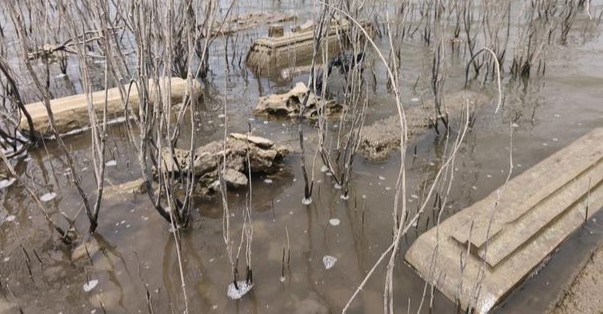
Rows of rectangular, cream-colored stones can be seen scattered along the edge of the reservoir in Wuryantoro Village, Wuryantoro District, Wonogiri Regency, Central Java.
Gravestones Emerging From the Reservoir Floor
These stones are actually gravestone markers from an ancient cemetery submerged beneath the reservoir. The site sits roughly 500 meters from the Wuryantoro Village Office, though reaching it isn’t easy, as it’s located in the middle of the now-receded reservoir basin.
Around the ancient graves, local residents can be seen going about everyday activities like fishing and farming, largely unbothered by the presence of the exposed gravestones.
Up close, some gravestones remain intact while others show significant erosion, varying in length from half a meter to two meters. Most of the markers, made from what appears to be limestone, feature a small hole at the center. While a portion of these stones have become fully visible as water levels dropped, several remain partially submerged. Some carry carved inscriptions, though these have become largely illegible due to erosion over time.
An Annual Dry-Season Phenomenon
Wuryantoro District Head Soemardjono Fadjari said the emergence of these ancient graves at WGM is an annual occurrence during dry season.
“Every dry season, these graves usually start becoming visible. But only partially so far, since water levels are still fairly high,” Soemardjono said when contacted by media on Wednesday, September 9, 2026.
He noted that the graves typically start appearing around August, but this year, the reveal has been delayed until September. “Usually they’re visible by August. This year, the water receded more slowly, so not everything has surfaced yet,” he added.
The Story of Eyang Raden Santri
Suparso, 77, a respected community figure in Wuryantoro Village, explained that this cemetery was originally located in Sentono Hamlet, Ngungkingsari Village. While the site is historically associated with Eyang Raden Santri, the burial ground actually served as a general community cemetery for Sentono residents.
“It used to be a village cemetery, but it became known through its elder figure, named Eyang Raden Santri. The cemetery also held his family’s graves, his children, grandchildren, and served as a public burial ground too,” Suparso told media on Wednesday, September 9.
According to Suparso, Eyang Raden Santri was originally an ordinary farmer from the local village. One day, while digging an irrigation channel near his rice field, a mysterious man approached and walked directly across the channel he was digging.
“Eyang Raden Santri confronted him, worried the channel would be damaged. The man told him to check whether his footsteps had actually caused any damage or not,” Suparso recounted.
Upon checking, Eyang Raden Santri found the irrigation channel completely undamaged. Struck by how strange this was, he decided to pursue and follow the mysterious man.
Once he caught up, the man scolded him for following. But convinced the stranger possessed some kind of supernatural ability, Eyang Raden Santri insisted on accompanying him. The man then led him to the Bengawan Solo River, where he built a simple raft for Eyang Raden Santri to ride.
“If you want to follow me, I’ll build you this raft. Once it starts moving, you’re not allowed to get off until it stops on its own,” the man told him.
Eyang Raden Santri followed these instructions, drifting along the Bengawan Solo River for several days until the raft finally stopped at Keblokan Hamlet, Sendang Ijo Village, Selogiri District, Wonogiri.
There, local residents found him weak and exhausted from days without food. The Keblokan community nursed him back to health, feeding him until he recovered.
“There, in Keblokan, Eyang Raden Santri converted to Islam and was taught to recite verses from the Quran. Afterward, he was told to return home and spread the teachings of Islam. That’s when he took on the name Eyang Raden Santri,” Suparso explained.
“As for the man he followed, we believe he was one of the Wali Songo, possibly Sunan Kalijaga, or perhaps Sunan Giri,” he added, referring to the revered Islamic saints traditionally credited with spreading Islam across Java.
Returning to Sentono village, Eyang Raden Santri went on to spread Islamic teachings throughout the community, eventually becoming one of the area’s most respected figures. Upon his death, he was buried in what is now the site submerged beneath the WGM reservoir.
Suparso recalled that many pilgrims once visited Eyang Raden Santri’s grave. “I used to go on pilgrimage there myself, the grave was fairly large. Before people went to the mosque, this was also a place for spiritual meditation. Pilgrims came from all over,” he said.
The Reservoir’s Impact on the Community
As widely documented, the construction of the Gajah Mungkur Reservoir submerged 51 villages spread across 7 districts in Wonogiri Regency between 1974 and 1981. The project also relocated residents and graves from Sentono village. According to Suparso, villagers were relocated as far as Jambi, while the graves themselves were moved to a site near the Wuryantoro Village Office.
“The old gravestones were discarded, and new, nicer ones were built at the new location. Including Eyang Raden Santri’s, his remains were relocated too. So the grave site out there in the reservoir is now empty; everything has already been moved,” he concluded.
Why This Matters for Travelers and History Enthusiasts
This annual resurfacing phenomenon offers a rare, temporary glimpse into a piece of local history that’s normally hidden beneath the water. For travelers interested in Javanese folklore, Islamic heritage sites, and the human stories behind Indonesia’s large-scale infrastructure projects, the exposed gravestones at Gajah Mungkur Reservoir serve as a striking, if fleeting, reminder of the villages and communities that once stood where the reservoir now sits.